
Ask the Experts
The Scarcity of Yellows
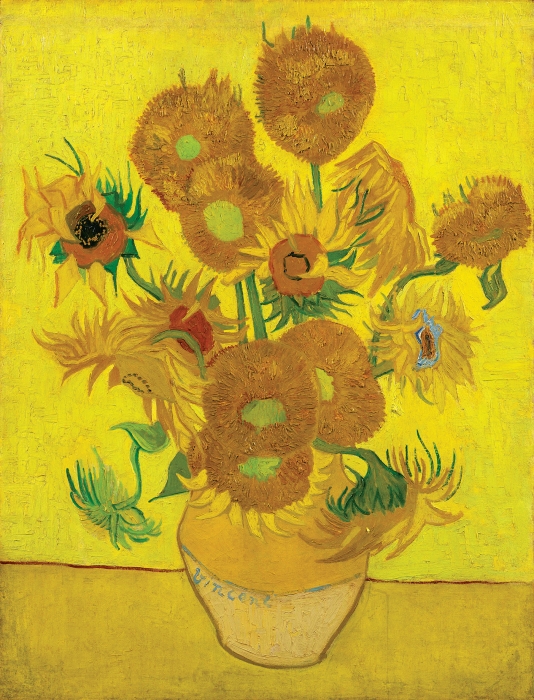
Van Gogh painting of sunflowers exhibiting severe color change in some yellow passages.
Ask the Expert: "Why don’t we see a lot of bright yellow in old paintings? Was it a style preference, or did they not have bright yellow paint back then?"
A: Probably the main reason paintings of antique age seem to generally lack bright yellow passages is that, for most of the history of the craft, painters lacked options for bright, permanent yellows except for a small handful of colors. Orpiment, an ancient arsenical yellow, was used in Egypt and the Near East, but was not widely adopted in Europe. Yellow Ochre, a terrestrial (mined) natural oxide in use since prehistory, is an earthy, neutral color still widely used today. Lead-tin yellow was used extensively in the European palette for centuries, starting in the Middle Ages. The overall assortment available to historical artists, however, falls short of the high intensity associated with the modern palette.
Aside from a lack of pigment variety, another reason why bright yellows seem absent from historical paintings is that some yellow pigments (like many other historical colors) proved not to be durable or lightfast as they aged. Yellow paints derived from plant-based sources like buckthorn berries or flowers have faded from light exposure. Indian Yellow, according to often-repeated mythology, was derived from elephant urine, stained from force-feeding plants which induced strong color. We’re not counting this one since a verified origin story is not available, but if the elephant story were true, we suspect this also would prove to be a fade-prone color. The lightest chrome yellows in works by Van Gogh have changed chemically to a dark, greenish brown color.
In the 18th and 19th centuries, yellow pigments were developed that were bright and more durable than colors which came before. Naples Yellow, first used in Ancient Egypt as a ceramic colorant, was rediscovered as an artist’s color, adding a pale, fleshy yellow tint to the palette which all but completely displaced the older lead-tin yellow. Yellows based on cadmium and cobalt were later introduced which far exceeded the intensity and performance of earlier materials (and in replacing lead-based colors, offered safer choices too).
Cadmium yellow, developed in the early 19th century, was adopted more broadly by mid-century. After 1900, the invention of a huge number of synthetic pigments and dyes made available a full range of yellows which, together with cadmium, still dominate the permanent palette. In the 21st century, art materials manufacturers have developed cadmium-free replacement colors which offer the permanence, authentic appearance and covering power of cadmium yellows in non-toxic formulas, finally opening up the full range of mixing solutions in the yellow color space without the risks associated with older materials.
To shop our full assortment of yellow paints in oil, acrylic, and watercolor, please visit our paint category.
Intended for reference only. Observe all package instructions. Dick Blick Holdings/Utrecht Art Supplies is not responsible for any damage to personal property that may result from use of the information presented herein. ©Copyright 2020 Dick Blick Holdings Inc. All rights reserved.