
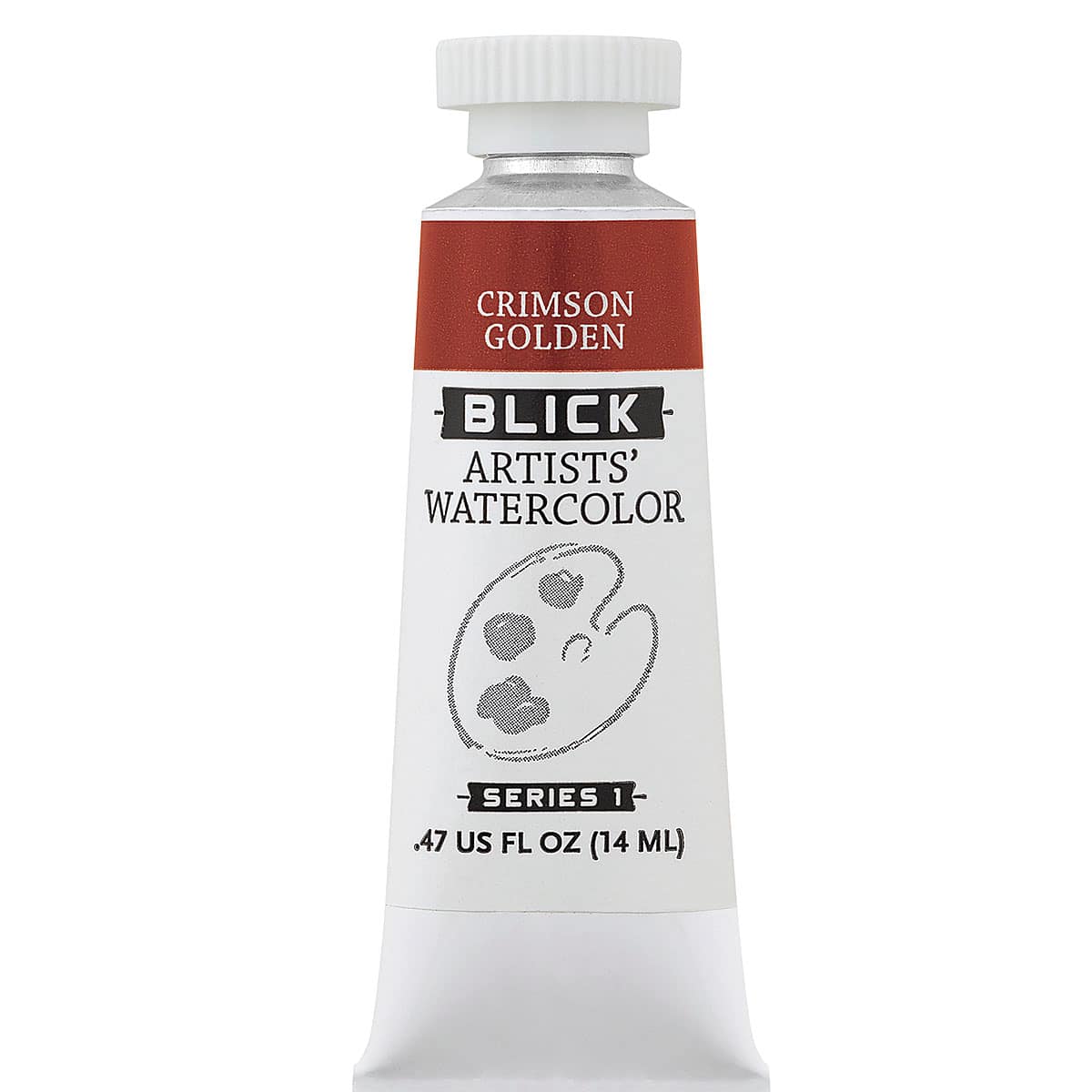
Blick Artists' Watercolor - Crimson Golden, 14 ml tube


Save For Later
My Wish Lists
Product Details
- Description:
- Artists' Watercolor
- Color:
- Crimson Golden
- Series:
- 1
- Format:
- Tube
- Size:
- 14 ml (0.47 oz)
Colors on Monitors -
Due to differences in users’ monitors, the colors presented are an approximation of the true color.
Reviews
Pigment Information
This color contains the following pigments:
PR83-Alizarin Crimson
PR101-Red Iron Oxide
Pigment Name
PR83-Alizarin Crimson
Pigment Type
organic
Chemical Name
1,2-dihydroxyantraquinone
Chemical Formula
C14H8O4
Properties
Alizarin Crimson, the traditional cool counterpart to Cadmium Red, is a clear ruby-red with a maroon masstone and a bluish undertone. It is the artist's principal deep red pigment, is transparent, and has good tinting strength. It creates bright rosy pinks when mixed with white, a range of purples and violets when mixed with strong blues, can be slow drying when used with oils, and is compatible with all other pigments. Permanent Alizarin Crimson mixes well with Ultramarine in acrylic and watercolor form. Permanent Rose and Quinacridone Rose are possible alternatives on a watercolor palette. Alizarin Crimson is a popular glazing color.
Permanence
Alizarin Crimson is considered fugitive or marginally lightfast, and the appropriateness of its use in the modern artist palette is a subject of debate. There are many concerns regarding its permanence, particularly when mixed with ochre, sienna, and umber, or when used thinly. It is the least permanent red commonly used by today's artists. Modern synthetic preparations of Alizarin Crimson have better permanence and lightfastness that the original natural pigment, which was extracted from the madder plant. Quinacridone pigments have been used to create a modern hue that closely matches the original hue, but many artists object that the transparency and handling characteristics are not the same as for the original.
History
The word alizarin comes from the Arabic word al-usara, meaning juice. The base ingredient of this pigment is the Madder plant (Rubia Tinctorum). It was used for dyes and inks among craftsmen in Ancient Persia, India, and Egypt as early as 1500 BC In 1804, George Field, an English dye maker, developed Madder Lake by binding madder to alum, a white powder. The German chemists Carl Grabe and Carl Liebermann produced the first synthetic variety of this pigment, most commonly known as Alizarin Crimson, in 1868. They used anthracene, which greatly improved the lightfastness. The Colour Index International designation PR83:1 has been used to identify this synthetic laked pigment.
Pigment Name
PR101-Red Iron Oxide
Pigment Type
earth, synthetic
Chemical Name
iron oxides (synthetic), iron oxide, silica, alumina, lime, and magnesia or hydrated iron oxide
Chemical Formula
Fe2O2 or Fe2O3 x H2O
Properties
Red iron oxide varies in hue and transparency, depending on hydration and slight impurities. Indian Red is a slightly duller, deep brick hue with a bluish undertone. It is very dense and opaque, with excellent tinting strength and covering power. It is dependable when mixing with all other permanent pigments and yields good flesh tints when mixed with Zinc White. It is the synthetic version of PR102, which is a pigment made from earth reds, or natural red iron oxides, and the names applied to PR101 and PR102 often overlap. The synthetic red iron oxides have mostly replaced natural red iron oxides and are brighter, stronger, finer, and more permanent. Indian Red is the highest grade bluish shade. Light Red, English Red, and Venetian Red are yellowish shades. Mars Violet is a dull and subdued bluish or purplish oxide.
Permanence
Red iron oxide is very lightfast with excellent permanence.
History
Natural red iron oxide comes from the mineral ore hematite, called bloodstone by the ancient Greeks from the word hema, meaning blood. It is one of the oldest pigments, has been used by every major civilization, and was an important mineral for medieval alchemists. It was not widely used in artists' materials until the 17th century and was not produced in large quantities until the 18th century.
Safety Data Sheet
UPC Code: 741389068075